
Hi, I help solopreneurs and agency owners grow their business without adding more headcount or making less profit. Check out what coaching with me looks like here.
I get emails and see LinkedIn posts weekly from freelancers and solopreneurs who are struggling to make ends meet. This always makes me sad, because when you run a consulting business the right way you can absolutely print cash and really change your lifestyle for the better.
And that’s the key – making more money in your business should not mean that your lifestyle gets worse. On the contrary, your life should get BETTER. When I was running my agencies (I’ve built and sold two), I eventually learned how to accomplish this. And that’s what I’m sharing with you in this article.
If you’re working for yourself and struggling to make ends meet, I want to offer you some advice on things that you probably need to change so that you can grow your business and work fewer hours instead of constantly grinding out the hours to get paid.
In this post I am speaking directly to individual solo consultants, not agencies. Agencies are a different beast than a solo consultancy because of headcount, account management, ability to offer more services, and more.
Here’s your blueprint for building a profitable solo consulting business.

Define your ideal client
Whatever your consulting, whether digital marketing or software development, you need to define the specific client that you do your best work for. Let me be very clear here:
If you don’t know who your ideal client is and the results you get for them on average, everything else will be MUCH harder.
You need to know:
- the type of business you have experience doing great work for;
- the type of business you love working with;
- their deep pains and desires;
- their business model (how they make money) so you can price to value, not commodity.
This will ideally be based off the kind of client/business that you have worked with in the past, whether at an agency or inhouse, because you will have a deeper understanding of the business and what the point of contact cares about.
While it is smart to pick a niche that has a lot of opportunity, the reality is that as a solo consultant you can only really take on 3-4 clients at a time and stay sane and still reach the revenue you need to be able to support yourself/your family.
Unless you are planning to grow a huge full-service agency, then I honestly recommend that you not really care about “opportunity”. Instead, if you want to stay self-employed for a long time then find the clients that you love doing great work for.
That is worth way more than “opportunity”.
Here’s a video I made about making any offer scalable and figuring out who to focus on working with:
Determine your pricing
Consulting is a business. To be profitable, you need to bring in more revenue than it costs you to deliver that work.
There are a few realities you must take into account before you find your rate, though we’ll discuss further down how to get away from selling your hours so that you can actually scale and not work 80 hours a week.
Realistic hours per week
First, recognize that realistically you can only work 25-30 hours a week for clients. This means that, assuming no days taken off, you will work for your clients 100-120 hours a month. If you’re currently full time employed, you might think “oh that’s not big deal, I work 40 hours a week right now so that means I’ll work less!”
The reality is that on the side from the actual client work, you have to do client management, sales, marketing yourself, and also allow for some days where you are less productive than you’d ideally be.
Don’t book yourself for more than 30 hours of client work a week, ever, unless you accept that you’ll be working 50+ hours a week if you do.
Expenses
Every business has expenses. Expenses in a solo business are much lower than in an agency with full-time employees, but expenses exist nonetheless. You probably have the following:
- Tools you use to deliver work
- Proposal software
- Processing charges (credit cards and ACH)
You have two actions here:
- Track all of them each month so that you can cut the ones that you’re no longer using;
- Calculate them against your revenue so that taxes (covered below) are easier and so that you have a clear view into your profitability.
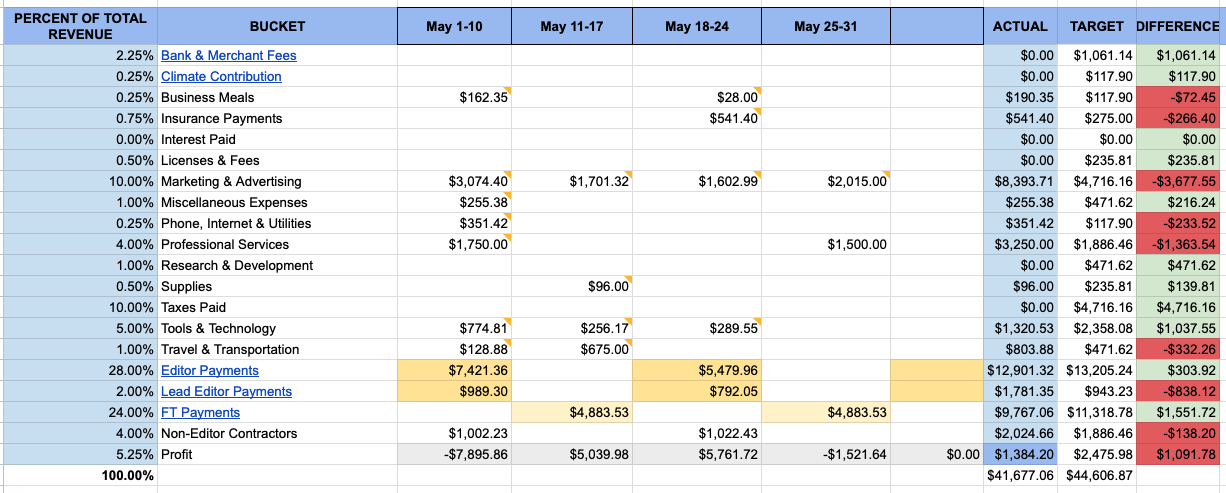
At my last agency, EditorNinja, we tracked them weekly and then I reviewed them monthly. This is how the spreadsheet looked:
Taxes
Second, recognize that you are now the one who has to pay taxes on the money you bring in. So if you bill 30 hours a week at $100/hr, you may be billing $12,000 per month before taxes. If you are a pass-through LLC and have $1,000 of expenses, then you have $11,000 of profit and will have to pay between $1,650-$3,000 of that $11,000 in taxes (depending on if you’re a simple LLC or an S-Corp).
So realistically, you have ~$8,000 from that $12,000 you’ve billed.
Doing the math
Now you get to do some simple math to determine your base pricing. Note that this is not your upper limit pricing, but rather the minimum that you need to make per hour of work to simply make ends meet.
Let’s say that you want to clear $100,000 per year in income after taxes. That is $8,333 per month.
This math is pretty easy, as we’ve already done it above. You need to bill ~$12,000 per month to hit this goal, if you accept that you are going to work 40 hours per week every week of the year (we’ll get to that in a bit) and only 2/3 to 3/4 of that will actually be billable.
The math is this:
$12,000 / 120 = $100 per hour
There you have it. If you want to make $100,000 in a year after taxes (and are keeping your expenses low), then you need to bill, on average, $100 per hour.
Not to burst your bubble here, but there are two more realities that you need to take into account.
- You will need to take some time off. You can only grind for so long and at some point you are going to need a vacation. This eliminates 25-30 hours of billable time from that month.
- Projects almost always go beyond their intended scope. You need to account for ~20% creep on hours worked.
You might think you only need to bill $100/hr to make the money you want, but I always recommend that you take the price you’d do it for and then add 20% on to the price.
If you’d pitch the project for $2,000, pitch $2,500. If the value is there and it’s the right type of client, they won’t care about $500 to get the job done right. If they balk at that and try to negotiate back, then you need to consider if what you are offering is worth that and if they are the right type of client.
Define your offer
Once you have your ideal client in mind, you need to define your offer to include:
- What your client needs, and
- The value you bring to them, which should also define what they can afford.
That second point is important. If you need to bill $10k/mo ($120k/yr before taxes and expenses) and you know that your ideal client realistically only has ~$1,000/mo to spend on marketing, then you have to take on a lot of clients to hit your revenue goals. You will also have a very hard time as a solo consultant doing services for clients like these unless you are very good at processes and automation.
If your clients are larger businesses, then you can realistically sign 3-4 clients who each pay you $3,000+ a month and you will end up working a lot less than the person with 10 clients at $1,000 a month doing services.
The takeaway: work with people with more expensive problems and more upside. They pay a lot better.
Types of offers
The reality is that some activities are worth way more to clients than other activities, based off the expertise required. To really structure your offer well at a price that your client is willing to pay, then you need to understand what the work is worth to them.
I’m not going to go into ascribing business value to the activities that you are proposing, but if your client does not understand what additional traffic/ad spend/content/email marketing/better site speed/whatever you are offering will get them, then you will likely not be able to charge correct prices.
There are three types of offers you can have:
- Strategy – this is where your client has a team and you are directing them with the strategy of what to do and where to go.
- Services – executing upon whatever your client needs whether that is content development, fixes on their website, writing code for new features, and more.
- Combination strategy/services – this is where a lot of consultants end up. You are doing the strategy and then some of the work, while relying on the client’s team to execute on other parts that you do not offer yourself.
At the beginning you will likely put together custom proposals for all of your clients. I recommend that you do this at first, but look at what the common needs are (aka what they are asking for) and then start “productizing” your offer. While a one-size-fits-all does not really exist, knowing the specific things that your clients will get is the best way to scale the work you are doing while staying sane and not working more hours.
We’ll talk about productizing another time, but it really involves two things:
- These are the things I do for clients;
- These are the things I do not do for clients.
This way, you can much more easily say no to the wrong clients, yes to the right clients, and specifically message your services towards those right clients.
In the past, I purposefully stated this on my website:

Message your services correctly
How many times have you looked at a consultant (or agency) website and seen generic things like this?
We offer SEO services and content marketing services
This is boring, bland, and not specialized.
This also does not work.
In the digital marketing world, I often blame keyword research for telling us that “SEO services” has more traffic and thus is going to get us more clients than something more specific.
But remember what I said about only needing 3-5 clients at a time to run a profitable and sane consulting business if you structure it right?
Let me show you something. Here is a screenshot from Credo’s analytics. I might get a lot more traffic from [seo consultants], but it does not convert well. However, the long tail (b2b facebook ads consultants, saas ppc agencies) converts way better!
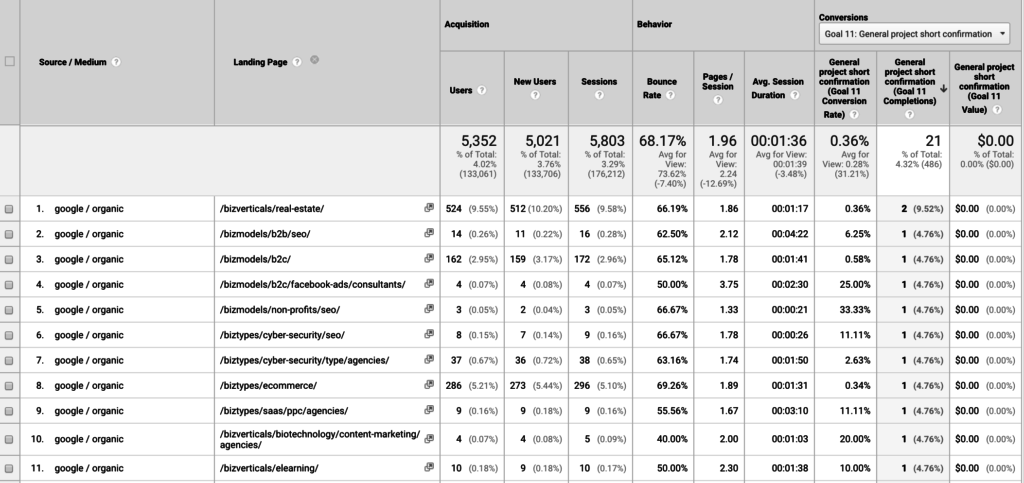
Each of these leads is worth multiple thousands of dollars. The more specific the query, the more likely it is to close as well.
Would you rather slug it out to get top rankings for [best seo consultant] and receive a lot of unqualified contacts wanting “seo services” for $250 a month, or would you rather rank #1 for [b2b facebook ads consultant] and receive 4 leads a month that convert and will each pay you $2,500 a month?
The choice is yours, but I know which one I would (and do) choose.
To get started here, read Million Dollar Consulting (aff link).
Structure deals for recurring revenue
The biggest mistake new solo consultants make is billing by the hour. I do not think that billing by the hour is the right move for either the consultant or the client. I will also admit that I have done it from time to time, and every time I do it I regret it immediately.
Hourly billing is a trap
Billing by the hour is a death knell to your business and your sanity. Because you’re literally selling your time, you will get into the trap of “I have to work so that I can make money” as well as “If I work more hours, I can make more money!”
This is not sustainable and is a false truth.
It is entirely possible to charge more by working less if you sell clients what will move the needle on their business and those activities are also high value to them.
Sell recurring services
I always recommend selling recurring services to your clients. Whether that is a package of content targeting specific keywords that will increase their traffic and get them new leads, ongoing link building or training to help their team get more links that will improve their rankings and their e-commerce business revenue, or an audit plus keyword strategy plus training with their team on SEO strategy, you can pitch all of this as recurring.
There are two ways to price work. I recommend the second if you can.
There are two ways to price your work:
- Figure out the amount of time the work will take you and what it will cost if others are helping, then add a multiplier on that (absolute minimum 3x, ideally 5-7x).
- Price to the value they’ll get, not the work you’ll be doing. This should be ~10% of the value they’ll get in the first year, and also be at least 5-7x what it costs you to deliver, though this can easily increase to 10-20x if you’re really good.
Give three options for every engagement
I used to say that you should spend a bunch of time figuring out what you think they need, then determine the hours needed, multiply it by your hourly rate, and quote just that.
I no longer believe this.
While it can work to close work, you’re giving them a yes/no decision.
Instead, you should propose three options for each engagement:
- 80% of what they need for 100% of what they state they’re expecting to pay.
- 120% of what they need (everything they want/need plus 1-2 more things) for 120% of their expected budget.
- 2x what they need for 200-300% of their stated budget.
The goal here is for them to say the first is not quite enough, the second stretches them a bit but is everything they want and didn’t even know they needed, and the third is out of reach but something to aspire to.
Here’s a video I did on the topic:
Negotiate on scope, not price
Never negotiate on your rate if you want to run a profitable business.
If you pitch the client on a big engagement and they are not able to pay it, then you can negotiate on the scope (to lower the price for them) instead of selling your time for less than it is worth.
Finally, if your client is pushing back on your hourly rate then they probably do not see the value in what you are proposing and you’ve likely already lost the deal. You need to then do a better job up front of quantifying why your price is worth it to their business.
Sell retainers like this
Over the last ten years running agencies and consultancies, I’ve seen sentiment around retainers shift completely.
At least as of the end of 2025, we are in a trust desert, where most companies have hired consultants and agencies, and most have been burned at least once, if not multiple times.
So, I no longer recommend simply selling a monthly retainer.
What do I recommend?
The offer I see work best is a shorter-term pilot, which is meant to diagnose what they really need, so that you can then pitch them on the right retainer instead of just any retainer. If you position it this way as you sell the project, you should get a high take rate on it.
Here’s a video I created about this topic specifically:
Spend less than you make
In personal finance as in business, if you want to be profitable (whether to save for retirement or to pay yourself), then you need to spend less than you are bringing in.
It sounds simple, but it’s true. This is where business operations can literally save your business.
First, track all of your expenses. You can do this in a spreadsheet, or get your bookkeeper (which I highly recommend having) to do it in Quickbooks or wherever they do your books.
Then, review your expenses every month, and then quarterly go back and look across your expenses to see what you are not using that you might still be paying for.
Early on in my career, around 2017, I remember going back through my monthly expenses and realizing that I was paying for ~$600/mo in subscriptions that I wasn’t even using! Just by cancelling those subscriptions I saved my business $7,200. I’ve since done this multiple times, probably saving myself tens of thousands of dollars.
If you’re reluctant to prioritize this, just ask yourself, “What could I do with an extra $7,200?” Hopefully that motivates you to put it on your calendar each month and do it!
Consulting’s secret to profitability: retention
Finally, retention is the ultimate consulting business profitability hack.
If you are able to retain your clients long term, then you get all of the following:
- More time working for paying clients instead of getting new business;
- Ability to charge higher prices because you have less availability;
- More consistent income without worrying about the usual feast and famine of consulting.
There are many ways to structure your consulting so that you retain clients long term.
First, communication. Every week you should be on a phone call with each of your retainer clients (this starts to break down around 4 clients, which is also why you shouldn’t have 10 clients at a time) to discuss what you’ve done, what they’re doing, and what you are working on.
Monthly you should be reporting what has been done and what is being worked on. If your client does not have an Analytics team or is not tracking numbers that you can tie back to success, then you should discuss the monthly numbers reporting they need.
This also gives you a chance to help them get better visibility into their business which improves their view of you as more than “a consultant” and gets you into the “business consultant” realm.
If you can tie your work back to their business and show them how much more revenue your work is making them, then you will never lose that client and you can raise rates on them as well should it come to that.
Automate your billing and reporting (as much as you can)
Finally, the more time you are spending billing/reporting is less time that you can spend doing work for paying clients.
Automating billing with Stripe
If you are spending 20 hours a month doing reporting and billing and can reduce this to 8 hours (1 day) per month, that is an additional 12 hours you get back in your month.
That is a full day and a half that you can spend:
- Working on another new clients
- Sleeping
- On vacation
- Playing with your dog
Get the point? Reporting/billing are overhead. They’re activities that you might (and should) be charging your clients for as being included in their retainer, but you can reduce the time it takes to do it and still provide them the same value.
So how do you automate your billing? I do it with Stripe (full disclosure: as of December 2025, my wife is employed by Stripe, but I’ve used Stripe since 2016, long before she was there).
There are a few ways I use them:
- Set up recurring invoices for ongoing clients. Set it up one time and your invoices are automatically sent each month;
- Set up subscriptions and send them a payment link, which then automatically charges their payment method (credit card or ACH) each billing period.
If you have a slightly more complicated revenue model, such as a percentage of managed spend and a flat rate per channel managed, then you need a slightly different setup.
The best advice I can give you here is to hire someone to do this work for you. The more time you spend determining what each client owes you each month, the less time you have to do work for paying clients!
Billing absolutely needs to happen consistently, as sometimes clients can take longer to pay than your payment terms, but it can be done pretty easily by a trained eye that you can pay less than what you are worth hourly to your clients. This is also another way to get more time – pay someone less than you make yourself per hour, get more hours back in your day/week/month that you can use to either bill more from clients or take your dog for a walk.
Automating reporting
Reporting can be a bit harder to automate and how you do it completely depends on the work you are offering and what you are tying your work back to.
I personally work with larger clients with dedicated analytics/data teams and so at the beginning we work together to get all of the important tracking in place. I also make sure to annotate their Analytics whenever a big release goes out so that we can tie performance back to changes we made.
Another way to do it is Dashboards within Google Analytics, if that is what your clients use. The vast majority of clients do, so this is a great place to give your clients transparency into where the numbers are going (if you are doing digital marketing consulting, for example). If you are building websites or something for clients, then your work being completed is probably all the reporting you need.
I tend to personally keep reporting for clients very light as I am working solely on strategy for them and doing audits, but agencies and consultants I speak with who do more services tend to also use tools like Klipfolio for easy dashboarding.
What about you?
What other questions do you have about running a profitable consulting business? I’d love to hear the challenges you have so I can help you out!
Note: some links within this post are affiliate links, meaning if you buy something through that link I may get paid a commission. I only recommend products that I personally use and pay for.